Think

America Is Closing Its API

For decades, America ran the most generous open API the world has ever seen.

Free trade agreements. Open borders for goods. Most Favored Nation status handed out like developer keys. The pitch was simple: let anyone plug into the American economic engine, send us your exports, access our consumer market, and the rising tide of efficiency will lift all boats.

It was the economic equivalent of a tech company launching a free, unlimited API and telling the world: build on us.

And build they did. China became the world’s factory floor. Mexico became the nearshore assembly line. American companies moved upstream into design, IP, and brand while outsourcing the actual making of things to whoever could do it cheapest.

If you’ve spent any time in tech, you’ve seen this movie before.

The Free Tier Is Over

Remember when APIs were free? Google Maps, Twitter, Facebook. They flung open their platforms with zero restrictions. Third-party developers flooded in and built entire businesses on top of them. The platforms got distribution and network effects. Everyone won.

I would know. We ran this exact playbook at Buddy Media, building on Facebook, and again at Troops.ai.

building on Slack. It worked incredibly well. Both companies were acquired. But eventually, Facebook and Slack looked at what we’d built and realized they were giving away the store. They natively integrated our killer features into their own platforms. The open API giveth, and the open API taketh away.

Then came the pricing pages. Twitter killed its free API and started charging. Google Maps jacked up rates overnight and thousands of startups scrambled to rearchitect. OpenAI and every major LLM provider now charge per token, metering every single request that touches their infrastructure. What was once free became a line item, then a serious expense, then a strategic bottleneck.

That’s a tariff. Dressed up in developer docs instead of trade policy, but the mechanism is identical. You built on our platform for free while we were growing. Now we’re charging because we realize the value of what we’ve been giving away.

@gokulr talked about this strategy playing out at Facebook and Google. The result? They are two of the very best companies in the world. And there’s a graveyard of startups to show for it.

Look at U.S. trade policy and tell me it’s not the same pattern. Tariffs on Chinese goods. Reshoring incentives through the CHIPS Act. Restrictions on technology exports. Universal baseline tariffs floated every few months.

The message is the same one every maturing platform eventually sends: you’ve been accessing our infrastructure for free, and that era is over.

@howardlutnick recently delivered this very message at Davos.

Outsourcing Your Leverage

In tech, the open API era gave way to vertical integration. The companies that actually won didn’t just build platforms for others to plug into. They owned the full stack. Apple designs its own chips. Tesla manufactures its own batteries. Amazon runs the logistics, the cloud, and increasingly makes the products it sells.

The lesson is straightforward: when you outsource everything, you outsource your leverage. Open systems are great for growth. They’re terrible for defensibility.

America is learning this now, and the stakes are a lot higher than a startup losing access to an API.

When you outsource your manufacturing base to a geopolitical rival, you don’t just create a supply chain dependency. You create a military vulnerability. The same country making your consumer electronics makes components that go into defense systems. The same rare earth minerals that power your iPhone power your fighter jets. If the relationship deteriorates and the API gets shut off, you’re not dealing with empty shelves at Walmart. You’re dealing with a compromised ability to build the weapons your military needs to function.

This is why the U.S. is now backing American companies to acquire mineral mines in the Congo, competing directly with China’s decades-long head start locking up critical mineral supply chains across Africa. It’s full stack integration at a national level. You can’t just design the chip or assemble the product. You need to own the mine that produces the cobalt and lithium that make any of it possible in the first place.

Apple started designing its own silicon instead of buying from Intel. America is starting to secure its own minerals instead of buying from China. Same logic, wildly different consequences if you get it wrong. Apple ships a slower laptop. America loses the ability to defend itself.

The Stack Is the Strategy

The shift has real costs. Rate-limited APIs slow innovation at the edges. Tariffs raise consumer prices. Vertical integration is expensive and operationally brutal. There’s a reason companies outsourced in the first place, and there’s a reason countries did too.

But the calculus has changed. The question isn’t “what’s the most efficient way to produce things?” anymore. It’s “what’s the most resilient way to produce things, and who captures the value when things get tense?” This is especially true for strategically important categories like AI, weapons, defense, pharmaceuticals, and healthcare.

Tech learned this lesson already. The most valuable companies in the world aren’t the ones with the most open platforms. They’re the ones that control the critical and most valuable layers of their own stack.

America is running the same playbook at nation-state scale. The API is closing. The free tier is gone. And the winners in the next era, in both tech and geopolitics, will be the ones who own their stack from the mine to the microchip.

America Is Closing Its API Read More »

One Degree of Change

“She wants you to take her out.”

“Come visit me for a weekend at school.”

“Let’s go check out Exhibit Hall A.”

“But have you thought about…?”

At first glance, these statements seem small and insignificant. But every one of them changed my life in ways I could never have imagined.

Life has a way of turning the tiniest moments into the most consequential outcomes. I was reminded of this over the weekend while skiing on the hill. I watched my fellow ski patrollers respond to a code on the side of the mountain, helping someone who had made just one wrong turn. A single degree off course was all it took to change their day—or even their life—forever.

The same holds true in our everyday interactions. The impact of those small moments may not reveal itself immediately—it could take days, weeks, or even years—but they carry the potential to alter the trajectory of our lives in profound ways.

One degree.

A friend of mine, Wiley, reminded me of this recently. It only takes one degree—a single small decision, action, or moment—to change someone’s life or even your own.

Think about the ripple effect of a simple “hello” to a stranger who may have lost hope.

Or the unexpected phone call to a friend you haven’t spoken to in years.

Or the question someone poses to you—or you pose to yourself—that unlocks a new path forward.

As we step into the new year, many of us will make resolutions and promises to ourselves and others. If you’re one of those people, remember this:

It doesn’t take a monumental shift to make a difference. Sometimes, the smallest adjustments can have the biggest impact.

You might not see the effects right away, but believe me, one degree can set you on a course toward a future you never dreamed possible.

One Degree of Change Read More »

Joining Michael Karnjanaprakorn On His Podcast

I recently had a chance to catch up with my friend Michael Karnjanaprakorn. We’ve known each other for at least a decade or so now from the early days of the New York Tech ecosystem. This was a fun one.

Full video below and here.

And, some highlights that Mike pulled out from our conversation.

Dan Reich: “Business is a video game.”

I asked Dan Reich who has sold four companies to Salesforce, Buddy Media, and Procter & Gamble:

“Why are you still building companies instead of retiring and riding off into the sunset?”

He shared a conversation with a fellow serial entrepreneur:

CEO: “Do you still play video games?
Dan: “Yeah, I do still play video games.”
CEO: “So do I. But this business is a video game, and it’s a game that other people gave me money to play. If I win, not only will I make them money, I’ll make money too. And I love the video game.”

Dan reflects on this analogy:

Dan: “He was right. The journey is the prize. I tell everyone I have a career conversation with: People who optimize for money are not happy, and people who optimize for happiness end up finding money.

In this episode, Dan dives into:

• His transition from 4x founder to building a venture studio.
• His playbook for building companies.
• His advice for navigating a post-exit journey.

Joining Michael Karnjanaprakorn On His Podcast Read More »

Joe Grand hacked time to recover $3 million from a Bitcoin software wallet

In 2022, I embarked on a crazy journey to unlock a Trezor hard wallet holding over two million dollars worth of cryptocurrency. It felt like a wild goose chase, each step filled with tension, anticipation, and ridiculous commentary in my group chats. As we got closer to cracking the wallet, we realized that there were many others out there facing similar predicaments, desperately needing help to recover their lost digital fortunes.

When Joe Grand finally succeeded in freeing my coins, it was a moment of immense relief and high-fiving. But more importantly, it sparked an idea. We saw an opportunity to assist others who found themselves locked out of their cryptocurrency treasures.

Thus, OffSpec.io was born—a company dedicated to helping people recover passwords, private keys, and other crucial cryptocurrency data from hardware and software wallets. Our mission is to provide a lifeline for those navigating the complex and often unforgiving world of digital assets, ensuring that no one has to endure the anxiety and uncertainty that I experienced.

And just this week, Joe did it again, this time with some help, and a very different problem and approach.

The video and story are here. Also posted below.

And if you or anyone you know are in need of some help recovering crypto currency, please drop us a line.

Joe Grand hacked time to recover $3 million from a Bitcoin software wallet Read More »

A Visit To The SCOTUS

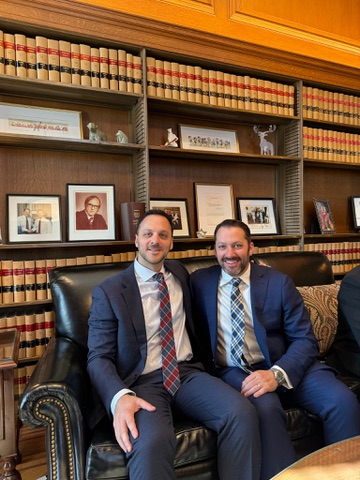
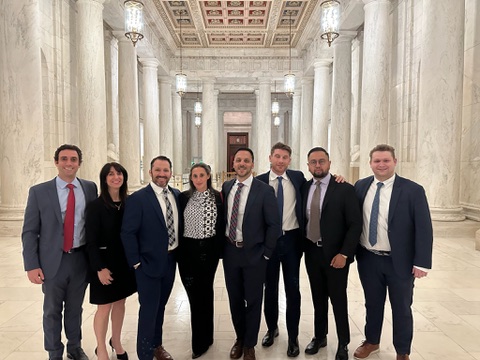
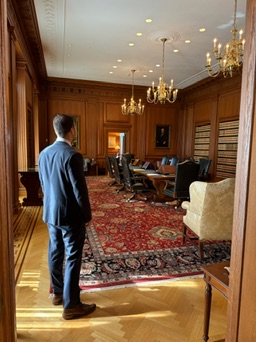
Yesterday, I had the privilege to visit the Supreme Court of The United States as a guest of Chief Justice John Roberts. He’s the 17th Chief Justice of the United States and will likely, and hopefully be, the Chief Justice for the majority of my lifetime.

We had an opportunity to spend time with him in his chambers before and after the oral arguments. The two items on the docket were:

  1. DEPT. OF STATE V. MUNOZ
  2. STARBUCKS CORP. V. MCKINNEY 

The oral arguments were undoubtedly interesting, dense in legalese and constitutional law, and dramatic in that you are sitting in the highest court in the land listening to arguments that could change history.

But the thing that left the biggest impression on me is this: it was a reminder that most people who serve our country deeply care about their work and their country.

Of course, some of our elected officials are misguided, but that’s what makes America, America. We get to support candidates we like and vote them into office.

America is not perfect. And if you spend any time on social media listening to pro-Hamas crowds screaming “death to America” you’d realize how imperfect we are.

We still have a lot of work to do, but there are indeed still great people trying to do the best they can. And these people put the country first and still fight, day in and day out, for our republic.

Thank you John, Jack and Sam for a great day.

A Visit To The SCOTUS Read More »

Supporting Feature Documentary “Primal Fear”

Story telling..

Facts and testimony..

These are powerful and mission critical to fighting any info war. And clearly, we are in one.

I remember when Steven Spielberg document testimony from my grandparents and their stories from the Holocaust, and so thankful he did.

We need more of it..

That’s what I’m excited to support Wendy Sachs and Debra Messing and the rest of their team in producing a piece that will detail and document this antisemitic disease that’s beginning to rot away our society.

In any society, antisemitism is the canary in the coal mine for a deep, uglier reality. It needs to be exposed because light is the best antidote for darkness.

Interviews will include some of the most active and vocal voices like Noa Tishby, Kirsten Gillibrand, Michael Rapaport, Dan Senor, Einat Wilf, Hillel Neuer, Sheryl Sandberg and more

There’s lots more to do but this is just another initiative of many that’s needed.

Thanks Wendy!

More about the documentary here.

EXCLUSIVE: Actress, producer, and activist, Debra Messing, has signed on to executive produce the feature documentary, Primal Fear about the explosion of antisemitism on college campuses, on social media, and in the streets since October 7, 2023, when Hamas attacked Israel. Wendy Sachs, the co-director and producer of SURGE, is directing the film and will also serve as an executive producer. 

Supporting Feature Documentary “Primal Fear” Read More »

A Post-Exit Podcast

There’s a ton of myths out there about folks who’ve started and then sold their companies, especially when it comes to what they end up doing next.

In the same vein, a lot of entrepreneurs who’ve poured their heart and soul into one big project for years suddenly find themselves lost or confused once it’s all over, wondering, “What now?”

We spoke about this and more on the “Exit Paradox” podcast.

Video here and below.

A Post-Exit Podcast Read More »

The Startup Nation and Track Records of Truth

I recently listened to Lex Friedman’s interview with Jeff Bezos. If you want to hear someone speak with incredible clarity and wisdom, listen to Jeff. There’s a reason he is the second richest person in the world.

But there was one topic that resonated with me more than anything.

Truth.

It seems like the world doesn’t care much about it these days. Just skim through social media and you’ll know what I’m talking about.

However, Jeff reminds us that “truth” is arguably the single most important factor that leads to success and prosperity.

“Yes, challenging. They [truths] can make people defensive even if that’s not the intent. But any high performing organization, whether it’s a sports team, a business, a political organization, an activist group, I don’t care what it is, any high performing organization has to have mechanisms and a culture that supports truth-telling.”1:29:14

The evidence is irrefutable. As of this writing, Amazon has about a 1.6 trillion dollar market cap making it the fifth richest company in the world.

If you look at the world’s most successful companies, they all have this trait. 

They consistently engage in the pursuit of truth, employing critical thinking, problem-solving, and scientific methodologies in their approach.

“And so science is all about truth-telling. It’s actually a very formal mechanism for trying to tell the truth. And even in science, you find that it’s hard to tell the truth. Even you’re supposed to have a hypothesis and test it and find data and reject the hypothesis and so on, it’s not easy.”Jeff Bezos, 1:30:10

Elon Musk also famously refers to “truths” and first principles:

“Boil things down to the most fundamental truths and say, ‘OK, what are we sure is true, or as sure as possible is true? ‘ And then reason up from there.” – Behind Elon Musk’s Management Philosophy: First Principles, Wall Street Journal

As of this writing, Elon Musk is the number one richest person in the world, with companies that launch rockets into space (SpaceX), produce self-driving cars (Tesla), and let humans transmit information electronically with just their brains (Neuralink). You only do that with capable leadership and truth-seeking.

There is another place where this truth-seeking discipline has taken shape over the past few decades leading to some incredible human achievements and prosperity, including, but not limited to the development of things like:


The list goes on.

This country also ranks #7 in the world for creating the most unicorns, has more than 100 companies listed on US exchanges, with a combined market cap of more than $150 billion, and has the fourth most companies listed on the Nasdaq after the United States, Canada, and China.

There is a reason Israel is called the Startup Nation.

And if that wasn’t enough, Israelis have among the world’s highest life expectancies and lower rates of “deaths of despair” from suicide and substance abuse. It’s also one of the few populations that are young and growing while all other wealthy democracies are aging and shrinking. According to a recent UN report,  it is also the fourth happiest nation in the world behind Finland, Denmark, and Iceland.

These achievements would not have been possible without dedicated hard work and a relentless quest for truth.

But, truth is hard.

“You have just asked a million-dollar question. So if I generalize what you’re asking, you are talking in general about truth-telling and we humans are not really truth-seeking animals. We are social animals.” Jeff Bezos, 01:28:21

This brings us to today.

War.

There is a hot war in the Middle East and an information war online.

Both sides understand the importance of truth or lack thereof. 

Iran and their proxies, like Hamas, understand that “we are social animals” and so the more death, destruction, and oppression they can inflict on their people (look what Israel did to us!), the more sympathy they can create for their cause. 

It’s why they use human shields. It’s why they hide bombs in children’s classrooms. It’s why they build terror tunnels under children’s bedrooms. It’s why they steal humanitarian aid. It’s why they use hospitals as terror bases. It’s why they scream “apartheid”. It’s why they bankrupt their community but make their leaders rich (with our taxpayer dollars).

It’s why they lie over and over again.

In short, they can prevent “truth-seeking animals” by pulling on the strings of our most animalistic tendencies and emotions, using social media megaphones we all have in our pockets. Who wouldn’t get upset when they see the photos coming out of Gaza? I know I do. It’s horrible and tragic. But that’s the point. They recognize that “truth-telling” for most people is hard, and so they prey on the ignorance and lazy thinking that many people have.

But ultimately, truth will prevail. 

And the truth is this:

One side wants dead Jews.

The other side does not want to die.

And if you don’t believe this, then just look at the track records of truth.

Or just take their word for it.

The Startup Nation and Track Records of Truth Read More »

Scroll to Top